Understanding 99.9% Uptime SLAs: Standards, Downtime Tolerance, and Measurement
A comprehensive guide to understanding 99.9% vs 99.99% uptime SLAs, practical monthly downtime tolerances, contract standards, and independent auditing.
Quick answer
What to know before reading further
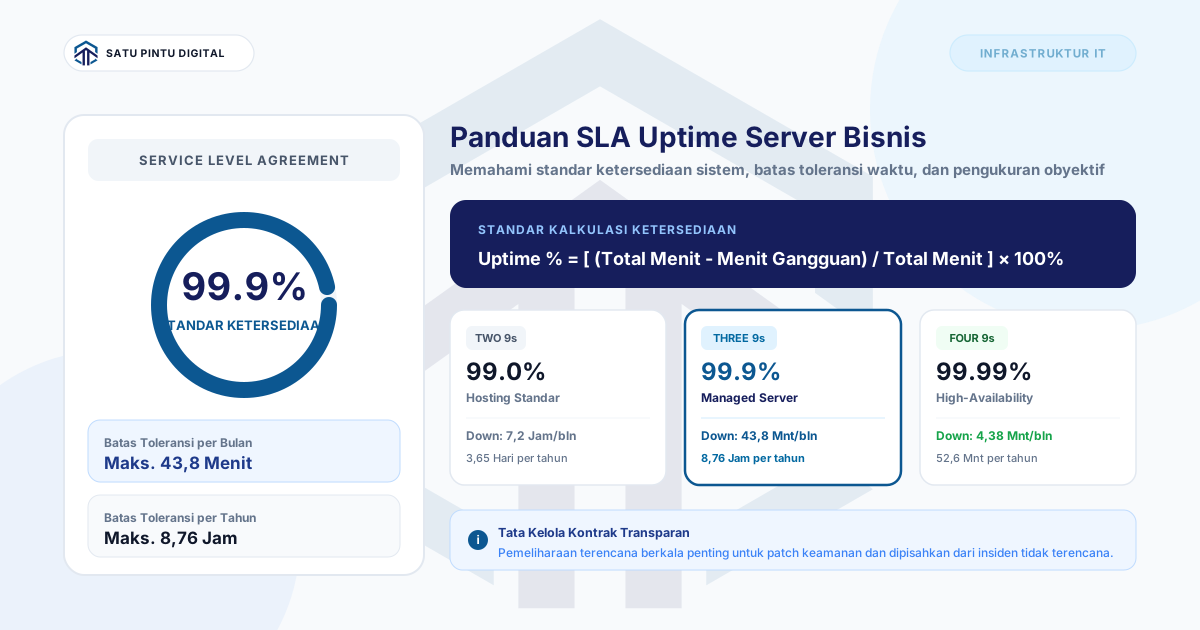
- A 99.9% uptime SLA (Three Nines) specifies a maximum acceptable downtime threshold of 43.8 minutes per calendar month or 8.76 hours per year. Understanding this benchmark helps leadership set realistic operational expectations, plan data continuity protocols, and select accountable infrastructure partners.
For executive leadership teams—whether Chief Operating Officers, financial controllers, or technology directors—a Service Level Agreement (SLA) commitment represents one of the most vital criteria when evaluating corporate server solutions. On proposals and technical datasheets, a 99.9% Uptime SLA is standard across professional service providers.
However, behind that percentage lies a concrete operational equation that directly shapes daily business continuity. Understanding what 99.9% availability truly signifies, how it translates into allowable operational tolerance, and practical methods for auditing it provides decision-makers with the clarity needed to build a resilient technological foundation.
Why Each “Nine” Matters in System Engineering
In modern Site Reliability Engineering (SRE), system availability is benchmarked according to a framework known as “The Nines”. Each additional digit after the decimal represents an order-of-magnitude leap in resilience, requiring progressively more sophisticated hardware clustering, automated network failover, and proactive incident triage procedures.
The mathematical conversion table below details how theoretical availability percentages translate to real-world operational tolerance over calendar periods:
| SLA Level | Industry Designation | Tolerance per Month (30 Days) | Tolerance per Year (365 Days) | Architecture Requirements |
|---|---|---|---|---|
| 99.0% | Two Nines | 7 hours 12 minutes | 3 days 15.6 hours | Single server node without automated failover |
| 99.5% | Two Nines Five | 3 hours 36 minutes | 1 day 19.8 hours | Standard server with periodic backup snapshots |
| 99.9% | Three Nines (Industry Standard) | 43.8 minutes | 8.76 hours | Managed cloud infrastructure with 24/7 proactive monitoring |
| 99.95% | Three Nines Five | 21.9 minutes | 4.38 hours | Clustered instances with dual-feed power and carrier redundancy |
| 99.99% | Four Nines (Enterprise HA) | 4.38 minutes | 52.6 minutes | Multi-zone automated High Availability (HA) failover |
| 99.999% | Five Nines (Mission Critical) | 26 seconds | 5.26 minutes | Global financial networks and critical telecommunications |
For the vast majority of commercial operations—such as healthcare record portals, enterprise ERP platforms, and customer-facing transactional portals—the 99.9% standard represents an optimal equilibrium between investment overhead and operational dependability. It indicates that the hosting environment is engineered to maintain unplanned disruptions below 44 minutes within a 30-day billing cycle.
The Mathematical Calculation of Service Availability
To verify whether your compute environment met its availability targets during a given billing cycle, management can utilize the standard calculation adopted throughout the global technology industry:
Availability Percentage (%) = [ (Total Period Minutes - Total Outage Minutes) / Total Period Minutes ] × 100%Operational Walkthrough:
Suppose that in a standard 30-day month (43,200 total minutes), a corporate application experiences 50 minutes of unplanned downtime due to an upstream network routing disruption:
- Total calendar minutes = 30 days × 24 hours × 60 minutes = 43,200 minutes.
- Total delivered uptime = 43,200 minutes - 50 minutes = 43,150 minutes.
- Delivered availability = (43,150 / 43,200) × 100% = 99.884%.
Here, delivered availability landed slightly below the 99.900% target. Having structured operational logging provides leadership with an objective, data-driven foundation for constructive performance reviews with infrastructure partners.
Understanding Standard Contract Exclusions
A well-structured SLA contract provides clarity and shared accountability. In enterprise hosting, standard frameworks reasonably exclude certain operational events from unplanned downtime calculations:
1. Scheduled Maintenance Windows
Routine maintenance—such as operating system security patches, hypervisor updates, and kernel hardening—is vital for preempting zero-day vulnerabilities. To safeguard user productivity, these updates are customarily conducted during off-peak windows (typically between 01:00 and 04:00 AM) with at least 48 hours of advance written notice. These planned activities are standardly excluded from incident downtime totals.
2. Upstream Public Network Transit Failures
If the hosting provider’s data center facilities operate flawlessly, but end users in a specific region experience connection hurdles due to localized ISP fiber cuts or public DNS propagation delays, those disruptions occur outside the direct physical perimeter of the server provider.
3. Application-Level Software Anomalies
If the virtual machine and underlying operating system remain fully operational, but an internal application script triggers a memory leak or an unoptimized database query locks tables, remediation focuses on application tuning. To explore these operational factors further, consult our guide on non-hardware causes of server downtime.
Compensation Mechanisms: The Service Credit Model
When an availability objective is not satisfied due to provider-side infrastructure incidents, the standard compensation mechanism used throughout the tech sector—including Google Cloud SLAs and AWS Service Level Agreements—is the issuance of Service Credits.
Service credits represent billing deductions applied to the subsequent invoice cycle corresponding to the variance level:
- Minor Variance (99.0% to 99.89%): 10% to 15% billing credit applied to monthly compute fees.
- Moderate Variance (95.0% to 98.99%): 25% to 30% billing credit applied to monthly compute fees.
- Substantial Variance (< 95.0%): Up to 50% or more credited toward future service periods.
This structure demonstrates the provider’s contractual accountability in upholding system reliability.
Three Strategic Practices to Objectively Measure Server Health
To ensure continuous transparency, organizations are advised to implement three operational safeguards:
- Deploy Independent Synthetic Monitoring
Configure external automated monitoring probes that ping service endpoints every 60 seconds from multiple geographic locations. This provides an objective, immutable availability log. Learn more about observability frameworks in our infrastructure monitoring fundamentals guide. - Reinforce Uptime with Proven Backup & Disaster Recovery Protocols
High server availability must always be matched by data resilience. Ensuring automated, encrypted backups are replicated off-site guarantees rapid recovery in the event of unexpected anomalies, as detailed in our guide on business backup and recovery strategies. - Partner with Providers Delivering Regular Transparent Reporting
Healthy technology partnerships thrive on open reporting. An experienced managed service provider provides regular reviews covering CPU utilization, memory thresholds, disk storage capacity, and security patch histories.
Conclusion
A 99.9% uptime SLA is a cornerstone governance tool that ensures digital business continuity. It offers leadership measurable reliability targets and establishes clear, professional expectations across technical and operational teams.
For organizations seeking to guarantee high-availability server operations without burdening internal staff, engaging a dedicated infrastructure partner represents a strategic approach to sustaining seamless business performance.
Looking for dependable business server infrastructure backed by transparent SLAs and proactive monitoring? PT. Satu Pintu Digital provides enterprise-grade Managed Server and Infrastructure Monitoring solutions designed to support your operational objectives—complete with 24/7 oversight, automated patching, and comprehensive reporting.
Read the sources
References and documentation
- Google Cloud Service Level Agreements Overview Industry reference documentation from Google Cloud detailing compute availability calculation frameworks and credit structures
- AWS Service Level Agreements Directory Official Amazon Web Services guidelines covering service availability definitions, technical boundaries, and infrastructure metrics
Frequently asked
Questions teams ask before implementation
- What is the allowable monthly downtime under a 99.9% uptime SLA?
- In a 30-day month (43,200 minutes), allowable downtime under a 99.9% commitment is exactly 43.2 minutes. For a 31-day month (44,640 minutes), the ceiling is 44.64 minutes. The widely recognized industry average is 43.8 minutes per month.
- Why is scheduled maintenance treated separately from SLA calculations?
- Planned maintenance is essential for deploying operating system security patches, hypervisor upgrades, and hardware upkeep. Global standards separate pre-announced maintenance windows from unexpected outages provided they occur during off-peak hours with adequate advance notice.
- How can businesses verify server uptime independently?
- The recommended practice is using external third-party synthetic monitoring tools that ping core endpoints from multiple geographical locations every minute, generating transparent, timestamped availability reports.
- Does an uptime SLA protect data integrity during system failures?
- An uptime SLA measures compute availability, not data recovery. Robust system design requires pairing uptime commitments with scheduled off-site automated backups and tested Disaster Recovery procedures.
This article is part of Satu Pintu Digital's field notes. The next article covers a related topic.
Keep reading