IT Cost Analysis: When Should Businesses Choose In-House vs Managed Services?
A comprehensive Total Cost of Ownership (TCO) evaluation of in-house IT teams versus managed service providers, covering operational overhead and hybrid models.
Quick answer
What to know before reading further
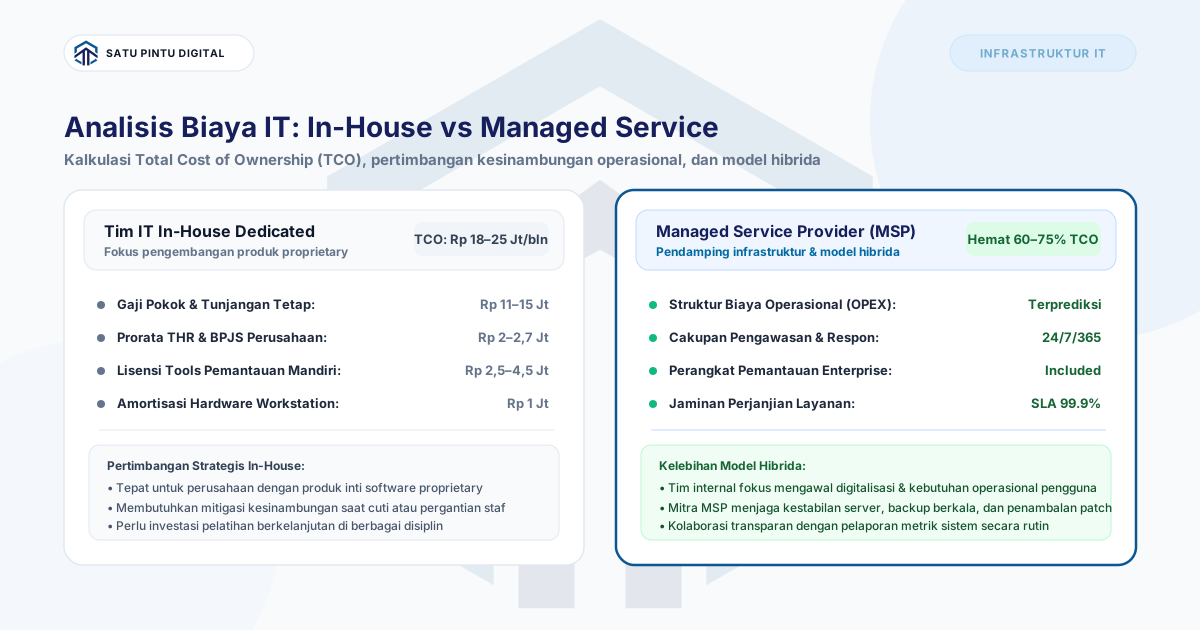
- Choosing between building an in-house IT squad or engaging a Managed Service Provider (MSP) depends on core strategic focus. Employing a dedicated internal sysadmin incurs a fully loaded Total Cost of Ownership (TCO) of approximately IDR 18–25 million per month when factoring in statutory allowances, workstation equipment, and enterprise tooling licenses. For growing enterprises, a hybrid model—where internal staff drive business applications while an MSP partner oversees infrastructure—provides optimal cost efficiency and 24/7 reliability.
In stewarding corporate expansion, allocating technology expenditure represents one of the most critical governance decisions facing executive leadership. For Chief Financial Officers, Chief Operating Officers, and business owners, the strategic question routinely centers on: “When should our organization recruit internal technical personnel, and when is partnering with a specialized Managed Service Provider (MSP) the more effective path?”
Frequently, initial budgeting processes focus solely on the gross base remuneration quoted on an employment offer. However, evaluated through the disciplined lens of Total Cost of Ownership (TCO), employing technical specialists entails a broader matrix of capital investment, tooling subscriptions, and operational risk factors.
Examining the authentic economic balance sheet alongside operational dynamics enables leadership to formulate an IT strategy that is cost-effective, scalable, and resilient.
Analyzing the Total Cost of Ownership of In-House IT Staff
When an organization recruits a competent mid-level infrastructure engineer (such as a Linux System Administrator or Cloud Engineer), the real monthly corporate cash outflow reflects multiple interconnected components:
| Expense Category | Operational Allocation Details | Estimated Monthly Outflow (IDR) |
|---|---|---|
| Base Remuneration & Fixed Allowances | Monthly salary for mid-level infrastructure practitioner | Rp 11,000,000 – Rp 15,000,000 |
| Prorated Statutory Holiday Bonus (THR) | Mandatory 1-month annual allowance amortized over 12 months | Rp 916,000 – Rp 1,250,000 |
| Mandatory Employer Social Security (BPJS) | Corporate contributions (Work Accident, Death, Pension, & Health) | Rp 1,100,000 – Rp 1,500,000 |
| Workstation Hardware Amortization | High-performance engineering laptop/desktop (24-month schedule) | Rp 1,000,000 |
| Enterprise Monitoring & Tooling Licenses | Standalone licenses for APM agents, log collectors, and remote access | Rp 2,500,000 – Rp 4,500,000 |
| Professional Training & Certifications | Annual technical upskilling (cloud architecture, system hardening) | Rp 500,000 – Rp 1,000,000 |
| HR Administration & Recruitment Overhead | Sourcing fees, technical evaluation platforms, and onboarding admin | Rp 800,000 – Rp 1,200,000 |
| TOTAL FULLY LOADED COST per MONTH | Real comprehensive corporate expenditure for 1 internal hire | Rp 17,816,000 – Rp 25,450,000 |
This aggregate represents the true expenditure for a single technical specialist. From an enterprise risk standpoint, anchoring mission-critical infrastructure to an individual resource requires careful operational contingency planning.
Key Operational Continuity Considerations
Beyond the direct balance sheet calculation, executive leadership must weigh three essential operational realities:
1. Operational Continuity and Shift Coverage
Digital enterprise operations run 24 hours a day, 365 days a year. A solo in-house employee works standard business hours, takes annual leave, and experiences occasional personal illness. When an unexpected system anomaly arises at 02:00 AM on a weekend, organizations require reliable escalation workflows to ensure essential services remain uninterrupted.
2. Multi-Disciplinary Skill Requirements
Modern business technology encompasses diverse specialized disciplines:
- Operating system baseline security and Linux server hardening standards
- Perimeter network filtering and firewall architecture
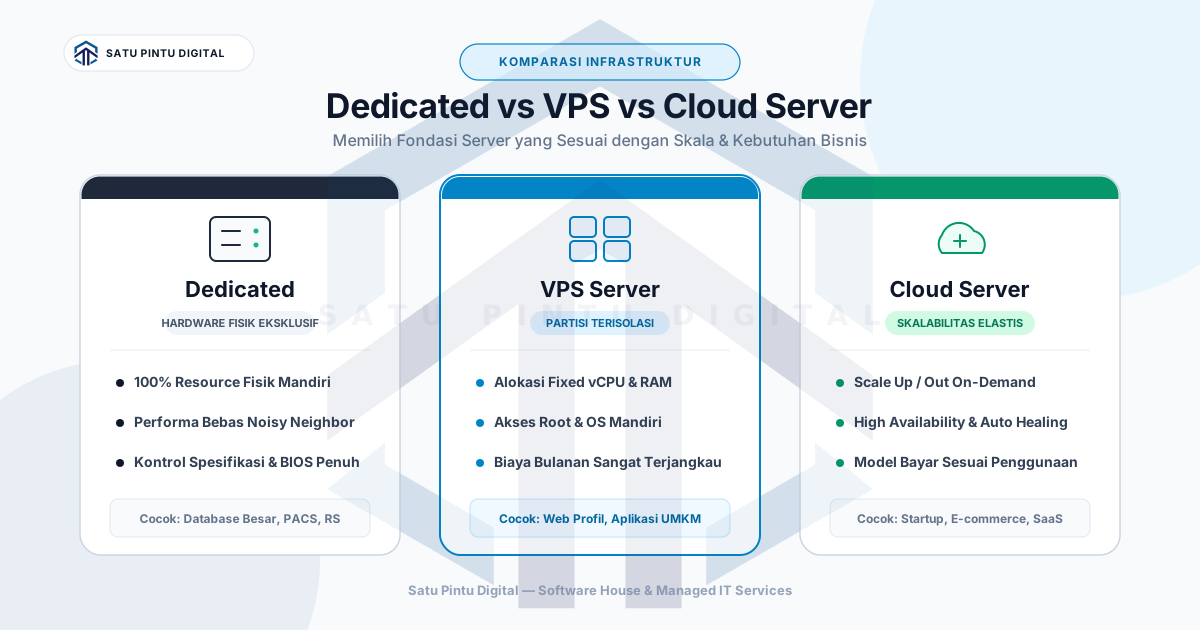
- Evaluating architectural trade-offs between dedicated, VPS, and cloud servers
- Automated data snapshots and disaster recovery execution
- Interpreting and managing business server uptime SLAs
For mid-sized enterprises, assembling an in-house roster covering all these distinct domains involves substantial recurring overhead.
3. Contractual and Legal Accountability
Internal employment relationships naturally focus on professional development and workplace goals. In contrast, engagements with managed service providers are anchored by formal Service Level Agreements (SLAs), offering executive leadership enforceable benchmarks regarding system availability and response times.
Strategic Comparison: In-House Team vs. Managed Service Provider
The table below contrasts the fundamental characteristics of both operating models:
| Evaluation Criteria | Solo In-House IT Specialist | Managed Service Provider (MSP) |
|---|---|---|
| Expense Characteristics | Fixed personnel overhead + capital hardware investments | Predictable monthly operational expenditure (OPEX) |
| Monitoring Window | Primarily oriented around standard business working hours | Continuous 24/7 proactive monitoring and incident alerting |
| Team Capability | Dependent on the individual practitioner’s specific background | Supported by a multidisciplinary squad (Sysadmins, Security, Network) |
| Tooling & Software | The enterprise procures standalone monitoring agent licenses | Comprehensive enterprise APM tooling included within service tiers |
| Core Organizational Focus | Balances end-user support requests with backend server maintenance | Focuses dedicated attention on upholding backend infrastructure stability |
Executive Decision Framework: Choosing the Right Model
To guide organizational planning, leadership can evaluate their strategic positioning using the decision flow below:
┌────────────────────────────────────────────────────────────────────────┐
│ Is proprietary software engineering the primary business value engine? │
├───────────────────────────────────┬────────────────────────────────────┤
│                YES                │                 NO                 │
│                 ↓                 │                 ↓                  │
│ Build an in-house developer team  │ Partner with an MSP to manage core │
│ focused on proprietary features   │ server infrastructure & stability  │
└───────────────────────────────────┴────────────────────────────────────┘
The Hybrid Model: Achieving Operational Synergy
For established mid-market enterprises (employing between 20 and 200 staff), the most widely adopted approach among seasoned executives is The Hybrid Model:
- Internal IT Staff Focus on Business Workflows:
Internal specialists direct their attention toward empowering everyday user operations through IT Helpdesk services, overseeing enterprise ERP integrations, and aligning technology projects with core revenue goals. - The Managed Partner Guards Backend Infrastructure:
The specialized service partner assumes accountability for operating system stability, midnight security patch deployments, off-site automated backups, and 24/7 incident response. - Structured Hardware & Licensing Procurement:
For workstation hardware rollouts and certified software licensing, companies utilize structured IT Procurement channels to capture volume pricing and standardized specifications.
Through this balanced division of responsibility, internal technical personnel are shielded from late-night alert fatigue, while corporate infrastructure operates with high-availability reliability.
Conclusion
The strategic choice between hiring internal IT personnel or partnering with a Managed Service Provider is fundamentally about aligning technology investments with overarching corporate objectives.
For organizations seeking to maximize budget efficiency without compromising system resilience, collaborating with an experienced infrastructure partner provides dependable operational continuity, transparent cost structures, and sustainable peace of mind.
Ready to optimize your company’s IT infrastructure and operational expenditure? PT. Satu Pintu Digital delivers comprehensive End-to-End Managed IT Solutions—ranging from Managed Server hosting and IT Procurement to dedicated Helpdesk services—designed to empower your growth with 24/7 engineering expertise.
Read the sources
References and documentation
- Gartner IT Spending and Staffing Benchmarks Industry benchmark reports from Gartner detailing global enterprise technology spending metrics and personnel allocation frameworks
- Ministry of Manpower of the Republic of Indonesia Official statutory guidelines governing employment standards, mandatory holiday allowances (THR), and social security requirements in Indonesia
Frequently asked
Questions teams ask before implementation
- What hidden cost components are frequently overlooked in internal IT budgeting?
- Commonly overlooked expenses include statutory annual holiday bonuses (THR), mandatory employer social security contributions, high-specification workstation hardware amortization, and ongoing commercial licenses for monitoring agents, centralized logging, and remote administration tools.
- When should an enterprise prioritize establishing an in-house engineering team?
- Organizations should prioritize in-house technical teams when proprietary software engineering forms the organization's core commercial value proposition, such as tech-first SaaS ventures requiring rapid, continuous daily codebase iterations.
- Is the purpose of engaging a managed service provider to replace existing IT staff?
- No. The objective is collaboration rather than replacement. In a hybrid framework, internal IT staff are relieved of routine midnight patching and infrastructure triage, allowing them to focus on employee productivity, helpdesk coordination, and strategic business automation.
- How can leadership objectively evaluate the return on investment of a managed service partnership?
- Evaluation is measured through consistent adherence to contractual Service Level Agreements (SLAs), transparent monthly telemetry reporting, prompt incident response benchmarks, and long-term system uptime stability.
This article is part of Satu Pintu Digital's field notes. The next article covers a related topic.
Keep reading