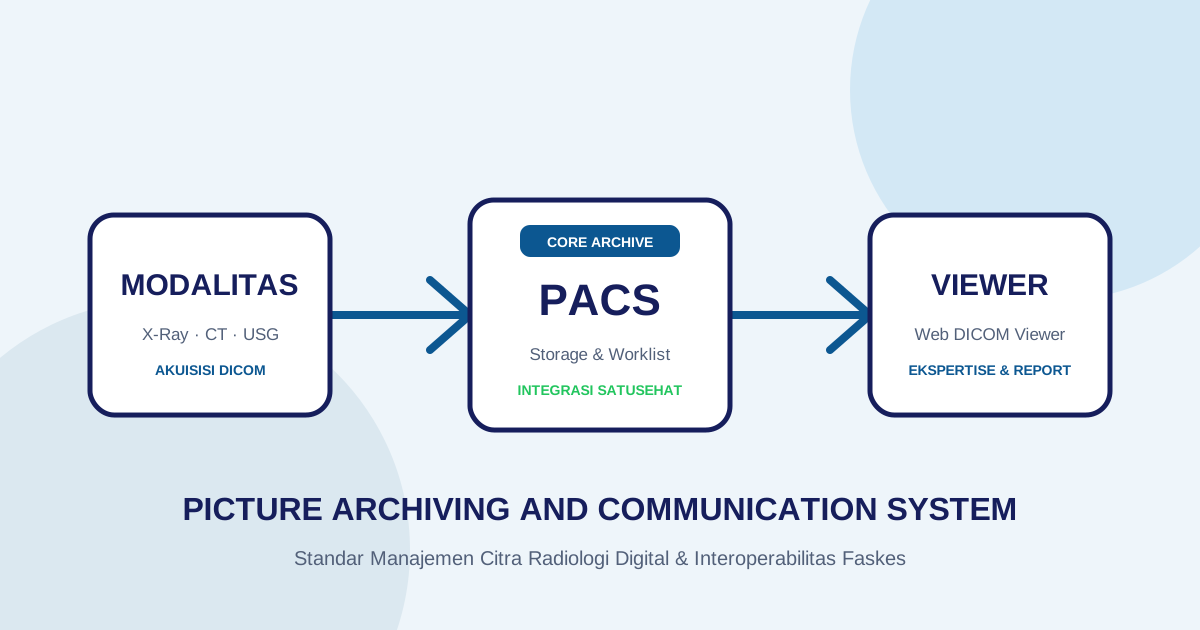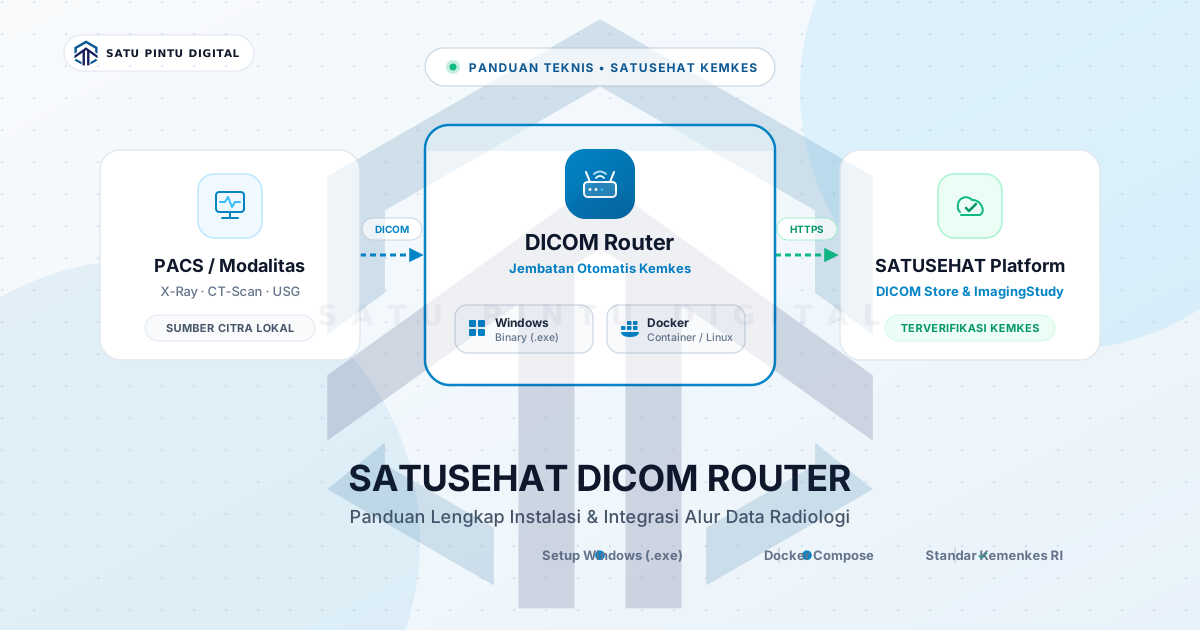
Smart DICOM Router: Connect Legacy Modalities Easily
How smart DICOM routers solve legacy modality issues: automated tag morphing, accession matching, and instant SATUSEHAT sync without manual editing.
Quick answer
What to know before reading further
- A Smart DICOM Router is an intelligent middleware layer capable of dynamically inspecting, modifying, and harmonizing DICOM tags before data reaches destination archives.
- It bridges older X-ray modalities lacking Modality Worklist capabilities to national repositories like SATUSEHAT NIDR without manual file editing.
The legacy radiology dilemma in the era of national health exchanges
For hundreds of hospitals and diagnostic clinics, national healthcare integration mandates (such as Indonesia’s SATUSEHAT NIDR) present a difficult operational dilemma. Mechanically and optically, X-ray generators, fluoroscopy units, and CT scanners acquired a decade ago continue to function flawlessly, producing crisp diagnostic images. Discarding capital assets worth hundreds of thousands of dollars purely due to software connectivity limitations is economically impractical for most healthcare facilities.
Yet when connected to basic default DICOM routers, technical roadblocks immediately emerge:
- Absence of Modality Worklist (MWL): Older acquisition machines lack software licenses for DICOM worklists. Radiographers are forced to type patient names and identifiers manually into the console.
- Missing or Mismatched Accession Numbers: Resulting DICOM files lack the exact Accession Number required to correlate with pre-existing clinical ServiceRequest resources on national health platforms.
- Proprietary and Illegal Tag Formatting: Patient identifiers contain regional symbols, spaces, or non-standard date conventions that trigger automated rejection from strict modern FHIR and DICOM parsers.
Consequently, healthcare IT personnel often resort to desperate manual workarounds: opening desktop hex editors or utilities like MicroDicom/dcmodify to edit raw .dcm tags file-by-file before transmission. This practice is slow, unscalable, and introduces severe clinical audit vulnerabilities.
This is precisely where Smart DICOM Routers provide an intelligent solution.
1. What separates a Smart Router from a Basic Forwarder?
Most basic DICOM routers operate as simple passthrough forwarders. Their architecture is strictly transactional: receive files on port 11112 (C-STORE SCP), verify whether a static accession number exists, and attempt an upload. If metadata tags are incomplete or misaligned, the transfer fails immediately, stranding files in an unparsed error directory without automated remediation.
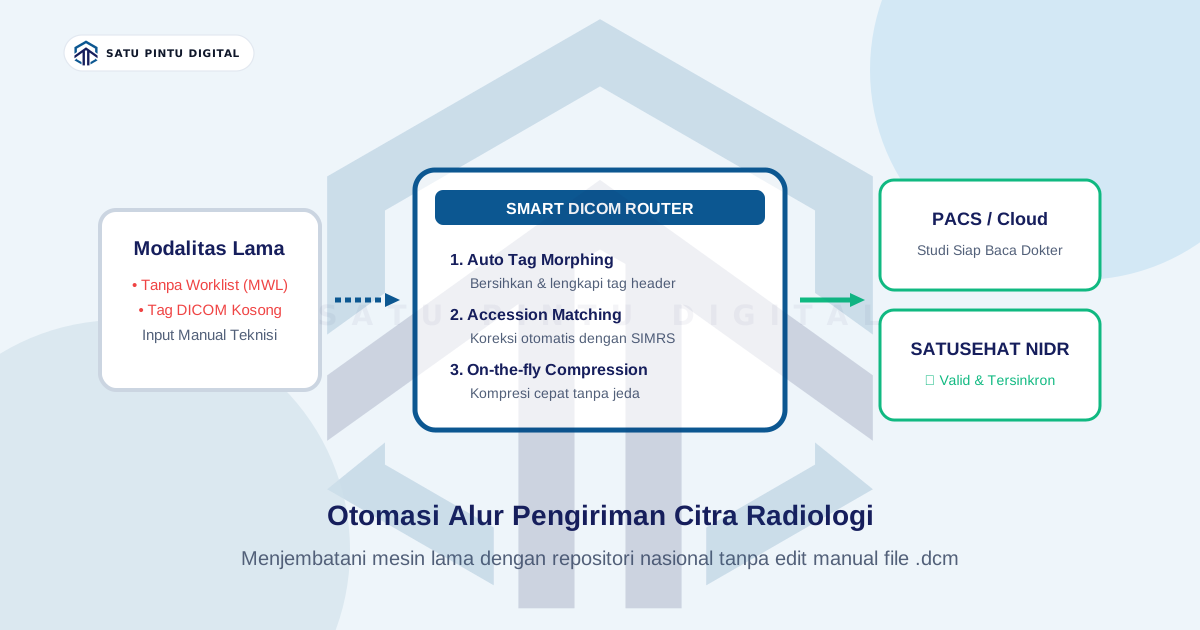
In contrast, a Smart DICOM Router functions as an intelligent middleware engine:
[Legacy Modality] (Manual Console Input / Messy Tags)
       ↓  DICOM C-STORE
[Smart DICOM Router Engine]
  ├── 1. Header Inspection & Rule Validation
  ├── 2. Automated Tag Morphing (Header Sanitization)
  ├── 3. Dynamic Accession Matching (EMR/FHIR Query)
  └── 4. On-the-fly Lossless Compression
       ↓
[Cloud PACS / National Health Repository] (100% Validated Data)
2. Four Core Capabilities of Smart DICOM Routing
Smart routing engines leverage several technical mechanisms to maintain seamless operational compliance:
A. Automated Tag Morphing (Dynamic Header Harmonization)
Legacy modalities frequently populate proprietary vendor tags or outdated timestamp formats (e.g., YYYY.MM.DD instead of YYYYMMDD). Tag Morphing allows system administrators to configure automated translation rules:
- Rewriting corrupted or vendor-specific tags into standardized DICOM Part 10 formats.
- Stripping illegal whitespace, special characters, and non-alphanumeric symbols that break national JSON parsers.
- Normalizing Institution Name and Station Name to align with verified facility registry codes.
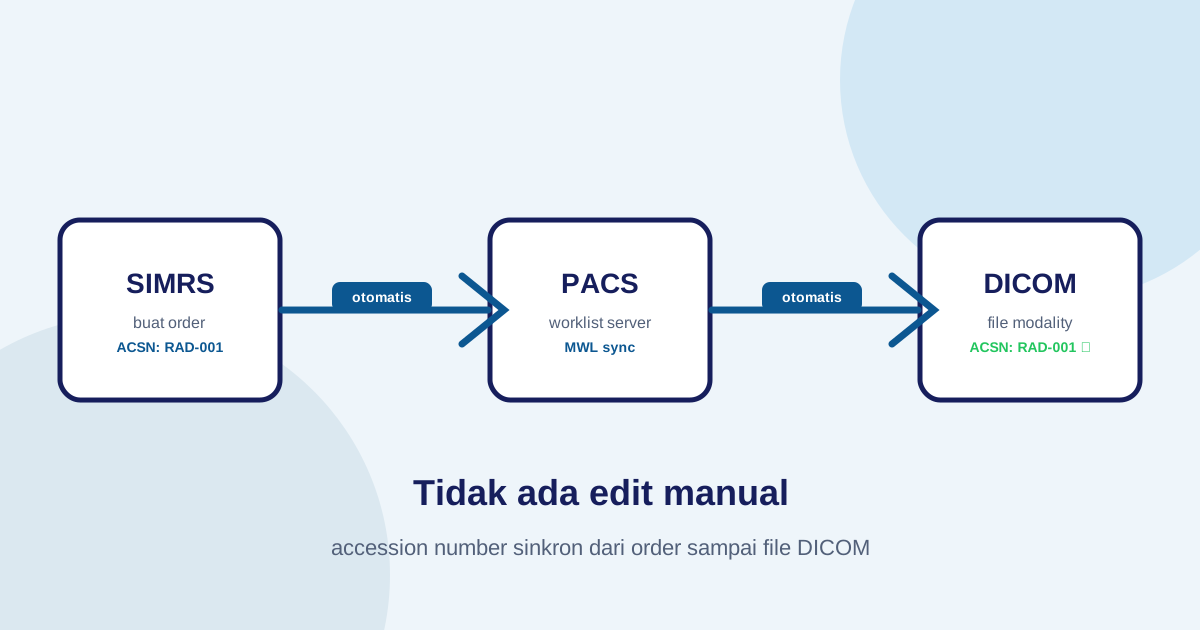
B. Dynamic Accession Matching (Intelligent Order Correlation)
When an imaging modality produces a study with an empty Accession Number tag (0008,0050):
- The Smart Router reads the patient’s Medical Record Number
(0010,0020)and examination timestamp. - The router instantly queries the hospital EMR database or active FHIR ServiceRequest queues to locate the corresponding diagnostic order.
- The verified Accession Number is programmatically injected into the DICOM header before the study is forwarded to national repositories.
C. Rule-Based Conditional Routing
Facilities frequently route diagnostic studies across multiple endpoints. Smart Routers direct traffic conditionally based on payload attributes:
- Routine general radiography: Forwarded simultaneously to the local viewing PACS and uploaded to national platforms.
- Occupational health check-ups: Routed to dedicated corporate client archive partitions.
- Routing logic executes transparently in the background keyed to the calling Application Entity (AE) Title or study description.
D. On-the-Fly Lossless Compression
Raw uncompressed digital radiography files average 30 MB per view. Transmitting uncompressed series over constrained internet connections creates bandwidth bottlenecks. Smart Routers compress imaging streams dynamically using industry standards (such as JPEG 2000 Lossless or JPEG-LS) prior to WAN transmission, slashing data transfer volumes by 50% to 70% with zero degradation to diagnostic pixel fidelity.
3. Operational Workflow: From a 2010 Machine to National Health Sync
By implementing a Smart DICOM Router, daily clinical imaging workflows become seamless:
- Patient Examination: The radiographer positions the patient on the legacy X-ray table and triggers the exposure as usual.
- Send Study: The technician transmits the acquired study to the Smart Router’s destination AE Title.
- Automated Remediation: Within seconds, the Smart Router sanitizes header tags, correlates the active hospital order identifier, and compresses the image payload.
- National Synchronization: Clean, fully compliant studies transmit directly to national repositories without human intervention.
- Web Error Correction Dashboard: In the rare event that a study cannot be correlated automatically (such as a typo in the patient record number), the file enters an error queue in the web dashboard. Staff can match the study to the correct order with one click—no server terminal or manual file editing required.
Conclusion
Interoperability compliance with digital health repositories should not compel healthcare providers to retire mechanically sound radiology equipment prematurely. By adopting Smart DICOM Routers, hospitals and outpatient centers can extend the productive lifecycle of legacy imaging assets while ensuring automated, secure, and compliant data transmission to modern healthcare networks.
Imagestro-PACS incorporates native Smart DICOM Routing directly within its cloud-native architecture—delivering automated accession number correlation, modern browser-based DICOM viewing, and intuitive web error resolution. Discover how cloud routing bridges your imaging equipment via the Imagestro-PACS free tier.
Key terms
Quick glossary
- Tag Morphing
- The programmatic capability of routing middleware to rewrite, inject, or sanitize metadata tags within DICOM file headers on-the-fly.
- DICOM C-STORE
- The fundamental DICOM network communication protocol utilized to transmit diagnostic image files from an acquisition device (SCU) to an archive receiver (SCP).
- ServiceRequest
- A standardized FHIR resource representing a formal clinical order for diagnostic imaging procedures requested by an attending physician.
- Legacy Modality
- Older generation clinical imaging machinery that operates in prime mechanical condition but lacks contemporary network software capabilities like DICOM worklists.
Read the sources
References and documentation
- DICOM PS3.4 - Service Class Specifications Specifications for C-STORE protocol and Storage Service Class implementations.
- SATUSEHAT DICOM Platform Documentation Indonesian national health platform technical guidelines for diagnostic imaging integration.
- IHE Radiology Technical Framework Industry standard integration profiles for radiology imaging workflows and Scheduled Workflow (SWF).
Frequently asked
Questions teams ask before implementation
- What is the fundamental difference between a basic DICOM router and a Smart DICOM Router?
- Basic routers act as passive conduits (receiving and forwarding data verbatim). Smart DICOM Routers possess algorithmic intelligence to parse tag payloads, validate order numbers against hospital databases, sanitize non-standard metadata, and execute rule-based conditional routing.
- Can older analog X-ray machines integrate with a Smart DICOM Router?
- Yes, provided the analog machine is equipped with a digital CR digitizer or retrofit digital radiography (DR) flat-panel detector outputting standard DICOM Part 10 streams.
- How does a Smart Router handle missing Accession Numbers if a technician enters patient data manually?
- The router automatically queries hospital EMR order queues using the patient's Medical Record Number (MRN) and timestamp, dynamically injecting the matching Accession Number before transmission to national platforms.
Transmit Radiology to SATUSEHAT Without the Setup Hassle
Connect your clinical imaging workflow—from modality worklists and automated accession numbers to web DICOM viewing and SATUSEHAT synchronization. Free Tier available for clinics and hospitals.
Content cluster